Expressionism is far more than just an art style from the early 20th century; it is a cry for truth. When we look at a painting from this era today—be it by Franz Marc, Wassily Kandinsky, or Ernst Ludwig Kirchner—we feel an energy that touches us directly. But what exactly lies behind this term that so lastingly shook the art world between 1905 and 1925? To understand Expressionism, we must leave the outer shell of reality and look into the interior of the artist.
What makes Expressionism Different from Impressionism?
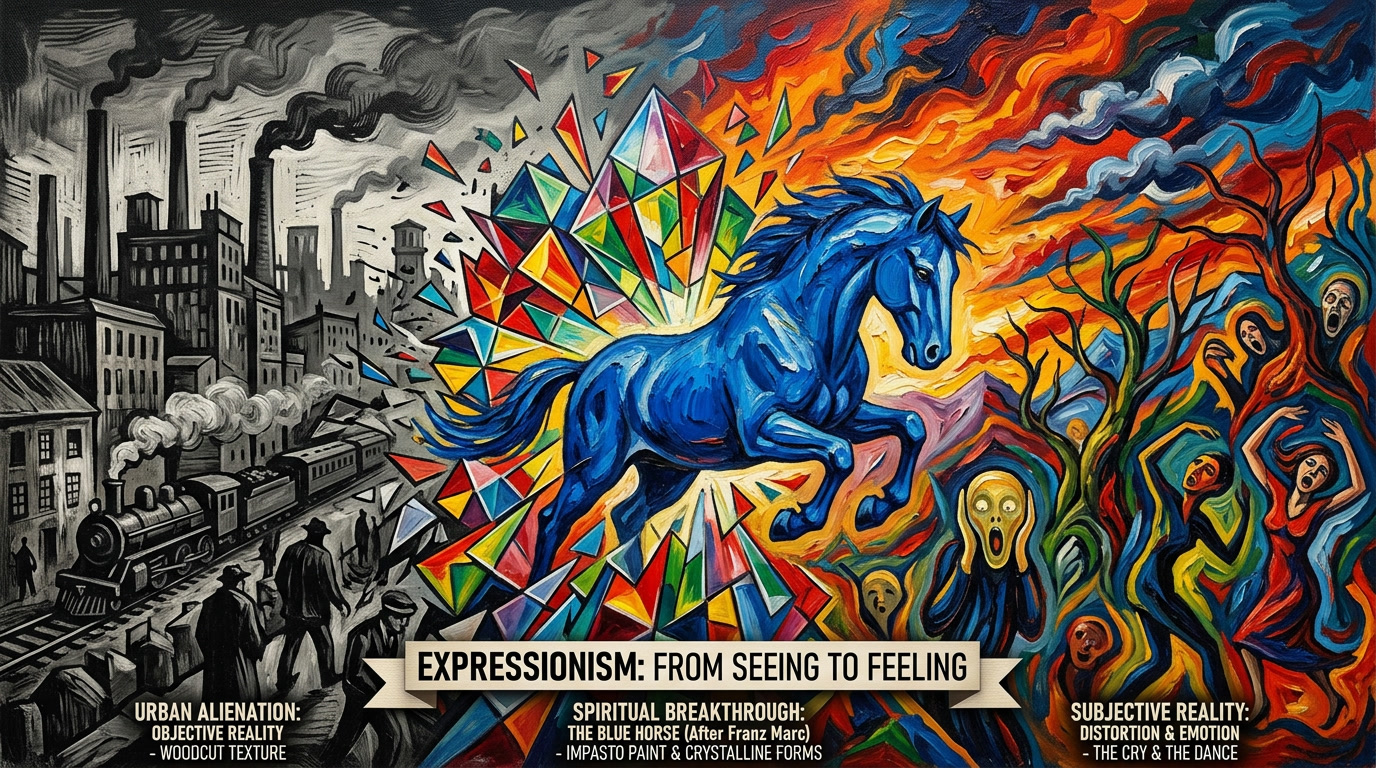
The word “Expressionism” is derived from the Latin expressio, meaning “expression”. While the preceding era, Impressionism, sought to capture the fleeting moment and the play of light on the surface, the Expressionists radically reversed this process. For them, it was not about what the eye sees, but what the soul feels. A tree no longer had to be green; a sky no longer had to be blue. If the artist felt sorrow, ecstasy, or fear, this was reflected in distorted forms and subjective color choices.
This shift was a reaction to the drastic changes of the time. Industrialization, the rapid growth of large cities, and the sense of an impending catastrophe (which eventually culminated in World War I) generated enormous inner pressure. Artists wanted to discharge this pressure. They sought an art that was no longer decorative but existential.
Which Groups Shaped German Expressionism?
In Germany, two main currents formed that shaped Expressionism. In Dresden and later Berlin, artists like Kirchner and Schmidt-Rottluff joined together in 1905 to form the group “Die Brücke” (The Bridge). Their style was raw, often aggressive, with hard contours and a preference for urban life and the human nude.
In Munich, however, “Der Blaue Reiter” (The Blue Rider) emerged in 1911 around Franz Marc and Wassily Kandinsky. Their approach was significantly more lyrical and spiritual. For Marc, art was a means of “purification”. He turned away from humans and toward animals, which he saw as symbols of an innocent, uncorrupted world. While “The Bridge” depicted the pain of civilization, the “Blue Rider” searched for harmony in the cosmos.
How Did Franz Marc Use Color as a Spiritual Language?
A central feature of Expressionism is the detachment of color from its natural function. Franz Marc developed a famous color theory for this, which we use as a basis for our reconstructions today:
- Blue stood for the spiritual principle, severe and masculine.
- Yellow embodied the gentle, cheerful, feminine principle.
- Red represented heavy, brutal matter.
In addition to color, the simplification of form is decisive. Details were omitted to reveal the “inner truth.” Artists often used woodcuts, leading to an edgy, flat aesthetic that we perceive as typically Expressionistic today. It is an art of reduction: everything non-essential is cut away until only the feeling remains.
Why Does Expressionism Still Matter in the Digital Age?
One might think that an art movement over a hundred years old would have little relevance today. The opposite is true. In a world that is becoming increasingly digital and often more superficial, Expressionism reminds us of the importance of subjective experience. It teaches us that our inner world is just as real as the outer one.
In our project “The 37th Sketch,” we use state-of-the-art AI to revive precisely this Expressionist spirit. We take Marc’s unfinished field sketches—fragments of a vision interrupted by war—and complete them with an understanding of his color theory and metaphysics. This is not about technical perfection but about the continuation of an emotional legacy. For us, Expressionism is not a closed era but a living dialogue between the past and the future.
Do you want to see the world through the eyes of the Expressionists? Explore our collection and find your personal window to the soul. Browse the The 37th Sketch Etsy shop now!
