The paintings of Franz Marc are not mere depictions of nature; they are visual manifestos of a deeply felt spirituality that goes far beyond the visible. Anyone viewing the works of this significant German Expressionist feels a stillness that is almost physically palpable. Marc was not a painter of the mundane, but a seismograph for the spiritual in a world that threatened to lose its soul through industrialization. His art is a radical search for “Inner Truth”—a search for which he paid dearly with his early death on the battlefields of Verdun in 1916.
Why Did Franz Marc Paint Animals Instead of Humans?
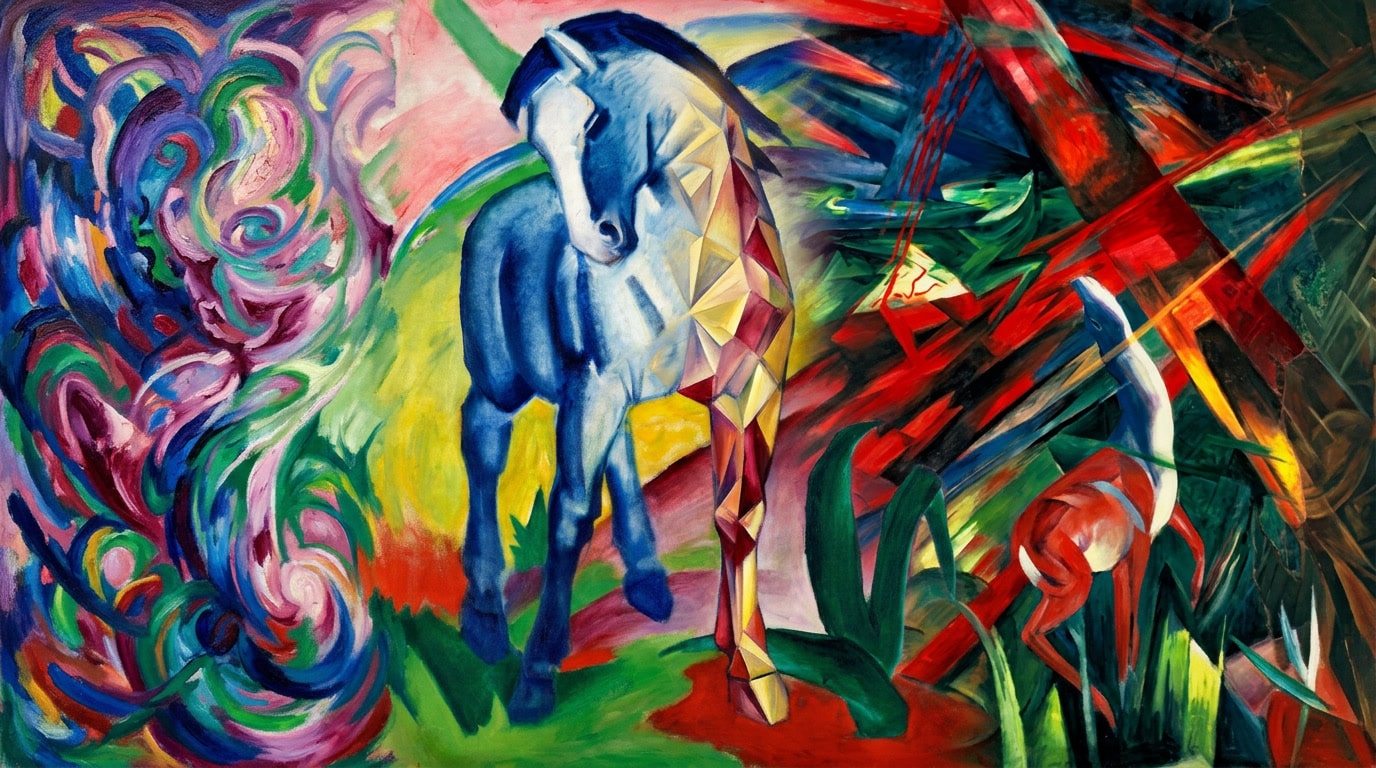
At the heart of Marc’s work lies the animal. For him, animals were the better, purer beings that, unlike humans, still lived in harmony with creation. In his iconic depictions of horses, deer, and cats, he did not seek anatomical correctness but the “organic rhythm of all things”. A blue horse in Marc’s work is not an animal found in a pasture; it is a symbol of spiritual purity and masculine strength. Marc did not want to observe the world from the outside but to recreate it “from the inside”.
His famous works, such as “The Tower of Blue Horses” or “The Yellow Cow,” illustrate this pantheistic approach. The animal becomes a messenger, inviting the viewer to self-exploration and dialogue with the divine. In a time of impending doom—Marc already sensed the approaching First World War in the “fragmentation of nature” by 1913—his animal motifs functioned as saving anchors of an intact world.
What is Franz Marc´s Triadic Color Theory?
No element is as crucial to Marc’s style as color. Together with Wassily Kandinsky, with whom he founded “Der Blaue Reiter” (The Blue Rider) in 1911, he developed a theory in which colors were assigned moral and spiritual values. This triadic order forms the backbone of almost all his compositions:
- Blue: Embodied the masculine principle, the severe and spiritual.
- Yellow: Represented the feminine principle, gentle, serene, and sensual.
- Red: Represented matter, brutal and heavy, weighing upon the world and always needing to be overcome by the other two colors.
This color symbolism was not a rigid corset for Marc but a living language. In his paintings, the colors fight with each other, permeate one another, and thus create a dynamic that perfectly captures the expressionist spirit. The detachment of color from real appearance toward the “essential color” was a revolutionary step in 20th-century art history.
How Did Cubism Influence Franz Marc´s Late Style?
From 1912, Marc’s style changed noticeably. Influenced by Robert Delaunay’s Orphism and the Italian Futurists, he began to facet his forms more strongly and dissolve them into prismatic shards. This “shattering of form” was a necessary step for him to penetrate to the core of things. In works like “Fate of the Animals” (1913), nature is no longer shown as a harmonious unity but as a structure torn apart by apocalyptic forces.
These cubist elements were not for abstract play but for depicting energy and movement. Marc wanted to make the “tremor of nature” visible. The landscape merges with the animals; everything becomes part of a large, vibrating field of force. Here, his path toward total abstraction is already hinted at, which he consistently pursued in his final years.
What Do the 1915 Sketches from the Field Reveal About Marc´s Final Vision?
When Marc was drafted in 1914, his work on canvas ended, but his spirit remained creative. In the trenches of Verdun, he created his last and perhaps most significant legacy: the “Sketchbook from the Field”. On 36 small sheets, he documented with pencil an almost complete turn toward abstraction. The representational world recedes almost completely; instead, geometric rhythms and organic interweavings dominate the compositions.
Themes such as “Creation” or the “Utopia of Order” determine these late sketches. In the midst of war’s destruction, Marc sought a new beginning, a genesis on a small scale. These drawings are no longer preliminary studies but independent masterpieces of drawing art, showing where Marc’s path would have led had he not fallen on March 4, 1916, struck by a shell fragment.
Explore the depths of Expressionism. Bring Marc’s revolutionary style into your home with our exclusive reconstructions that complete his vision. Visit The 37th Sketch Etsy shop now!
