I sometimes wonder what Franz Marc would have said if, in the trenches near Verdun, he had held not just his pencil but a tablet. Would he have laughed? Or would he have recognized in the cold logic of circuits a new form of that “Utopia of Order” he so desperately sought in his final letters? The debate over whether artificial intelligence can be creative is often conducted with almost religious stubbornness. Skeptics invoke the “soul,” while proponents point to “processing power.” But perhaps the answer lies somewhere in between, in a space Marc would have called the “metaphysics of art”.
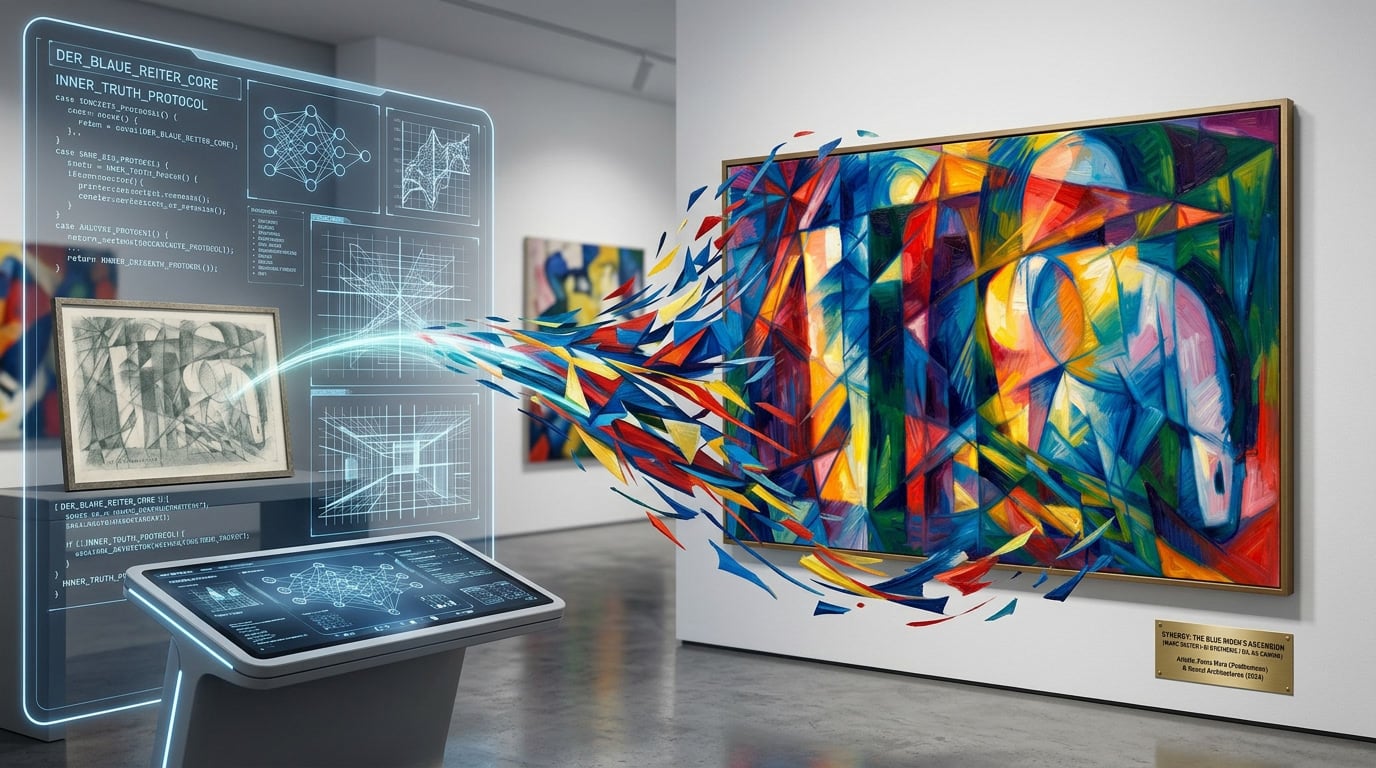
Creativity isn’t a magical spark leaping from a void. It’s a process of distillation. Marc didn’t copy nature; he shattered it to penetrate its core, to that “Inner Truth” hidden behind the visible world. When we apply our algorithms to the Sketchbook from the Field today, we are essentially doing something similar. The machine doesn’t “invent” in the human sense, but it combines probabilities in a way that holds a mirror up to us. It takes the 1915 fragment and brings the mathematical logic of Marc’s color theory—blue as the spiritual, yellow as the gentle—to a conclusion we hardly dared to imagine.
Can a Machine Complete What a Human Artist Left Unfinished?
A computer isn’t afraid of death. That’s its greatest disadvantage compared to an artist like Marc, whose entire late phase was marked by the premonition of the end. Nevertheless, AI possesses a form of “objective creativity.” It’s free from the clichés we humans often fall into when trying to paint “like Marc.” The AI analyzes the cubist forms and the rhythmic distribution of colors in Marc’s 1913/14 work and applies this logic to the unfinished sketches. It’s a form of digital alchemy.
Imagine software recognizing the direction of a pencil stroke made by a trembling soldier over a century ago. It doesn’t understand the pain, but it understands the dynamics. In this synergy between the human spirit that provided the impulse and the machine that fills the space, something new emerges. Is that creative? If the result makes us see the world through the eyes of “animal metaphysics” again, then the question of authorship becomes almost secondary.
What Happens When Franz Marc´s Color Laws Become an Algorithm?
Marc sought a purification of the world through abstraction. He wanted to free things from their material burden. Ironically, the digital world is the ultimate place of this weightlessness. A pixel has no weight. An algorithm doesn’t suffer from hunger or cold. In this sterility lies an opportunity: AI can reconstruct the purity of Marc’s visions without the clouding of human sentimentality. Our 4K Giclée prints are the result of this cool but precise creation.
In the end, we realize that AI is not a replacement for the artist, but an extension of his arm beyond the grave. We use technology as a tool for artistic restoration to give Marc’s color theory the honor it deserves. It’s a dialogue. Marc provided the soul; we provide the algorithm. Together, we create the 37th sketch that Marc could never draw.
