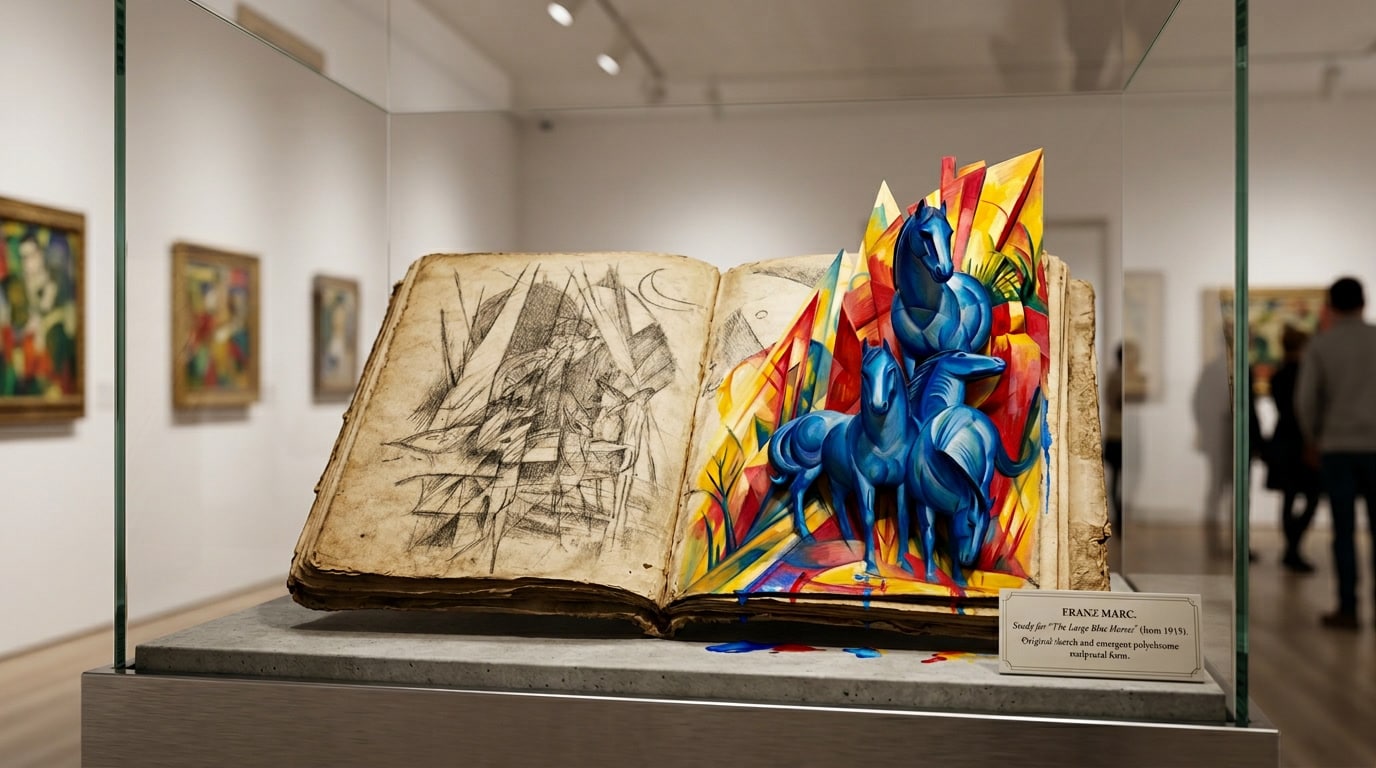
The quiet within the Lenbachhaus in Munich usually feels like a shield against the noise of the city, but in 2005, for me, that silence was different. It felt like an interruption. Standing before the remnants of an artistic life cut short, the weight of what was missing became heavier than what was actually there. I was looking at thirty-six small, fragile pencil sketches—the Skizzenbuch aus dem Felde. These were the final thoughts of Franz Marc, captured in the mud and the madness near Verdun in 1915. They were grey. They were quiet. They were unfinished. Yet, within those graphite lines, there was a pulsing energy that seemed to beg for the vibrant colors that defined Marc’s earlier, revolutionary work with the Blue Rider. The question wasn’t just a matter of art history; it was a human one: what if the war hadn’t happened, and Marc had been allowed to finish his last legacy?
The Skizzenbuch aus dem Felde isn’t just a collection of drawings; it is a bridge that was broken by a shell splinter in 1916. In those pages, Marc was moving away from the purely representational world into something he called animal metaphysics—a search for the spiritual soul of the universe through the eyes of the creature. He was reaching for a “Utopia of Order” while his own world was falling into the greatest chaos humanity had ever seen. The transition from his massive, pulsing oil paintings of 1913 and 1914 into these small field sketches shows a man stripping away the noise of the world to find its core. Our project, The 37th Sketch, serves as a digital reconstruction of that path, using the tools of the twenty-first century to honor a vision that 1915 couldn’t sustain.
How Did Franz Marc Use Color?
Reconstructing these sketches isn’t about simply “coloring in” the lines like a child’s book; that would be an insult to the complexity of Marc’s genius. It requires a deep understanding of his specific color theory—a system where colors weren’t just aesthetic choices but spiritual declarations. For Marc, Blue was the masculine principle, the spiritual, and the severe. Yellow was the feminine principle, gentle, serene, and sensual. Red was the matter, brutal and heavy, always to be fought and overcome by the other two. When we look at a sketch like “The Peaceful Horse” or “The Fox,” we aren’t just guessing which hue fits best. We are applying an algorithmic restoration based on the master’s own laws.
The AI we use functions as a modern brush, guided by the historical DNA of Marc’s style. It decodes the pressure of the pencil, the rhythm of the stroke, and the way he abstracted the forms of nature to find their “inner truth”. We are looking for the point where art history meets algorithm. This process allows us to see how “The Blue Horses” might have evolved into something even more ethereal and abstract had Marc returned from the front. It is about bringing the “Blue Rider” revolution into the digital age, creating a synergy between human intuition and machine precision to finish the unfinished work.
How are Franz Marc´s Pencil Sketches Transformed into Digital Art?
What we create are not mere reproductions of existing paintings; they are Digital Originals. This distinction matters. In a world of mass-produced prints, these works represent a new category of art—one that bridges 1915 and today through technical excellence. Each piece is rendered at 300 DPI with 4K resolution, ensuring that when they are brought to life as high-quality Giclée prints, every nuance of the reconstructed color and the original pencil line is visible. The museum-like appearance is intentional. We want these works to command the same respect in a modern living space as they would in a gallery hall.
These reconstructions are for those who understand that art is not a static thing kept behind glass. It is a living, breathing conversation. By integrating these expressionist landscapes and animal motifs into modern interiors, we are allowing Marc’s spiritual vision to finally find a home. Whether it is the abstract expressionism of “The Fox” or the symbolic peace of a horse at rest, these prints bring a sense of history and depth that few other interior art pieces can offer. They are a testament to the fact that even a century later, a vision of peace and spiritual order can still resonate through the noise of our own time.
What Does The 37th Sketch Mean for Franz Marc´s Legacy?
Ultimately, The 37th Sketch is about historical justice. It is about my initial spark—that moment of realization that Marc’s story was left on a cliffhanger. By focusing on the “Utopia of Order” and the animal metaphysics that Marc held dear, we are fulfilling a mission of artistic restoration. We aren’t replacing the master; we are following the breadcrumbs he left in his pocket at Verdun. These thirty-six sketches were seeds. We are simply providing the light and the color they needed to grow.
The result is a collection that honors the past while embracing the future. It is a way to own a piece of a “what if” scenario—a glimpse into an alternate art history where the colors of the Blue Rider never faded into the grey of the trenches. It is about reclaiming the soul in art, one reconstructed stroke at a time.

