The Story Behind the Sketches
A century-spanning collaboration between Franz Marc (1880–1916), one of history’s greatest expressionists, and the cutting edge of artificial intelligence — completing the 36 pencil sketches he left unfinished in the trenches of Verdun.
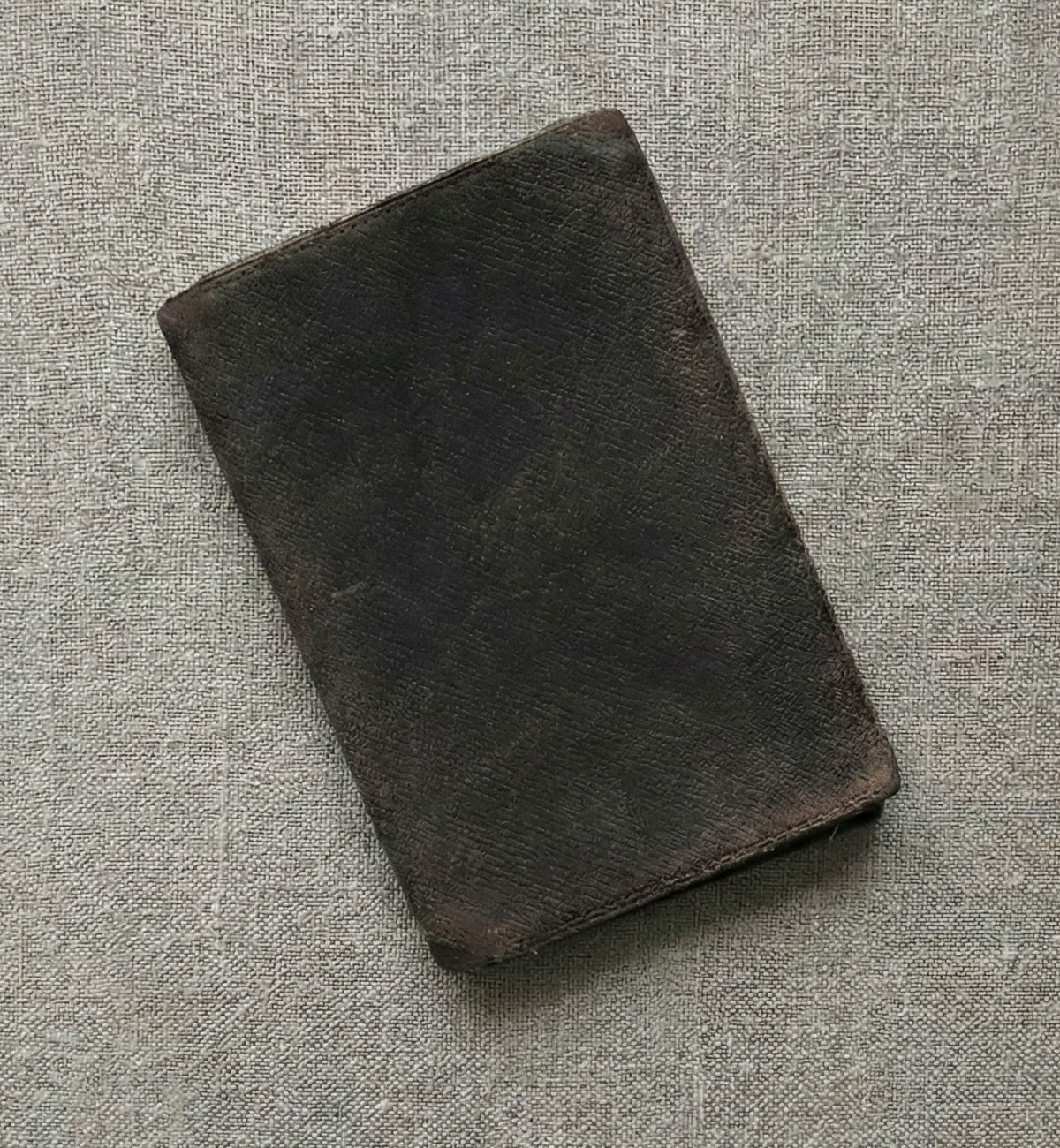
Sketchbook from the Field
Between March and June 1915, amidst the mud of the Western Front, Franz Marc carried a tiny booklet—measuring just 16 x 9.8 cm—in the breast pocket of his uniform. Close to his heart, this „Sketchbook from the Field“ became a talisman against the horror surrounding him.
Unlike other war artists, Marc refused to document the visible destruction. There are no trenches, no ruins, no corpses in these 36 sheets. Instead, he withdrew into a spiritual microcosm, sketching a „counter-theology“ to the war: creation, harmony, and cosmic order.
Fallen at Verdun
Marc’s attitude towards the war shifted from a hope for „cleansing“ to the realization that it was the „vilest trap humanity has set for itself.“ He sought to overcome the „disharmony of reality“ through the absolute purity of art.
On March 4, 1916, during a reconnaissance ride near Braquis (Verdun), Franz Marc was struck by a shell splinter. He died instantly at the age of 36—leaving his sketchbook as a finalized testament of unfinished visions.
The Four Cycles of the Sketchbook
Art historical research reveals that these 36 sheets are not a random collection, but a structured narrative. Leading scholars identify four distinct thematic clusters that oscillate between the poles of creation, destruction, and spiritual utopia.

Genesis (Creation)
About one-third of the sheets depict creation. Marc counters the destruction of 1915 with the explosive energy of a new beginning.

Animal Metaphysics
Deer and horses are no longer just nature studies. They become spiritual energy carriers, dissolving into transparency to resist the gravity of war.

The Abstraction of War
Marc depicts war not as a human battle, but as a cosmic antagonism of forms. Aggressive wedges pierce organic softness—pain expressed through geometry.

The Utopia of Order
Even in the trenches, Marc sketched designs for embroidery and paper. A flight into the strict order of ornamentation to hold back the chaos.
The Code Beneath the Graphite
The 36 sheets of the sketchbook are monochromatic—ghosts of graphite on paper. Yet, for Franz Marc, color was never random; it was a grammatical system of the soul.
Long before the war, Marc established a strict metaphysical color theory. To restore his sketches authentically, we treat his written definitions not as artistic suggestions, but as algorithmic constraints. We do not guess; we execute the rules he established in 1911.
Not Invention, But Restoration
Is this what Franz Marc would have painted? We cannot know. But we know it is how he painted.
We feed our AI strictly with Marc’s surviving oil paintings from 1913-1914. We constrain the algorithms to his specific brushstrokes and his metaphysical color laws defined in the „Blue Rider“ era. This is not generative chaos; it is a disciplined, digital restoration based on the roadmap he left behind in pencil.
Step 1
Original Sketch
High-resolution scans of Franz Marc’s 1915 pencil sketches from “Skizzenbuch aus dem Felde”.
Step 2
AI Interpretation
Advanced reasoning image models analyze Marc’s color theory and style to imagine the completed work.
Step 3
Upscaling
High-fidelity enhancement to museum-quality resolution suitable for large-format printing.
Step 4
Final Artwork
Digital masterpiece ready for download and printing on archival paper.
Become Part of Art History
Each restoration is available as a high-resolution digital download,
perfect for printing and framing in your own collection.

