The founding of “Der Blaue Reiter” (The Blue Rider) in 1911 marks one of the most significant turning points in modern art history. It was not a school in the traditional sense, but a spiritual community, an editorial collective established by Franz Marc and Wassily Kandinsky. Together, they aimed to shatter the stagnant conventions of academic painting and pave the way for “the spiritual in art”. In an age obsessed with materialism and technical progress, Marc and Kandinsky sought a new, inner truth.
How Did Franz Marc and Kandinsky Found Der Blaue Reiter?
It all began with a scandal. When Kandinsky’s “Composition V” was rejected by the Munich New Artists’ Association (NKVM), he and Marc resigned in protest. This split was the birth of the Blue Rider. Franz Marc found in Kandinsky not just a colleague, but a kindred spirit. While Kandinsky approached total abstraction, Marc remained with his animal motifs, yet both were united by the conviction that art must possess a metaphysical dimension.
The name of the group was no coincidence. Marc loved horses, Kandinsky loved riders, and both loved the color blue. For both, blue represented the spiritual, the masculine, and the transcendental. The “Blue Rider” became the symbol of a departure into a new era, where emotion would triumph over the mere depiction of reality.
What Was the Blue Rider Almanac and Why Was It Revolutionary?
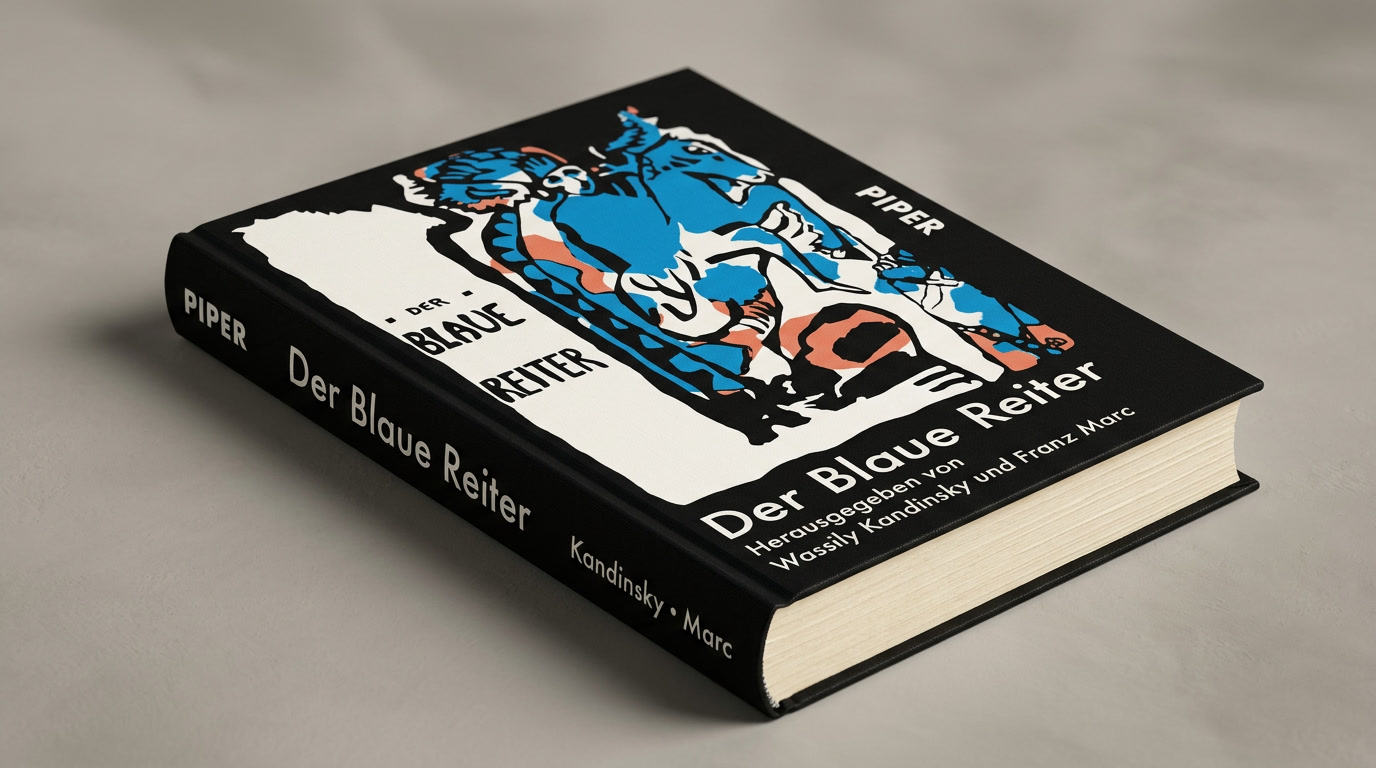
The centerpiece of the movement was the “Almanac Der Blaue Reiter,” published in 1912. It was far more than an art catalog. Marc and Kandinsky gathered essays on music, Bavarian folk art, children’s drawings, and non-European artifacts. They wanted to prove that true art knows no boundaries—neither geographical nor temporal.
In his contributions to the Almanac, Marc often spoke of the need for “purification.” He saw animals as symbols of innocence, which he contrasted with the “ugly human”. His goal was to see the world through the eyes of animals to grasp its true, untouched structure. This pantheistic worldview decisively shaped the style of the Blue Rider. The group promoted an art that no longer reflected outer form but the “inner sound” of things.
Which Art Movements Influenced Franz Marc´s Style?
Within the group, Marc was the one who built bridges to other avant-garde movements. He was fascinated by the cubist forms of Robert Delaunay and the dynamic energy of the Italian Futurists. He integrated these influences into his work, leading to that characteristic faceting seen in masterpieces like “The Tower of Blue Horses”.
The Blue Rider’s exhibitions were international in scope. They showcased works by Henri Rousseau, Robert Delaunay, and even Arnold Schönberg. It was a melting pot of ideas. Marc often acted as a mediator and organizer, whose diplomatic skills held the group together. But the Blue Rider was more than just the sum of its members; it was a feeling, a longing for a world no longer consisting only of matter.
How Did World War I End the Blue Rider Movement?
The outbreak of World War I in 1914 brought the movement to a sudden end. Kandinsky had to leave Germany as a “hostile alien” and return to Russia. Marc was drafted and fell at Verdun in 1916. The group dissolved, but its impact remained unbroken. The ideas of the Blue Rider laid the foundation for 20th-century abstract art.
What remains is the vision of art that touches the soul. In our project, “The 37th Sketch,” we continue this thought. We use technology not as an end in itself, but as a tool to complete the unfinished dreams of Franz Marc from his “Sketchbook from the Field”. It is an homage to the spirit of the Blue Rider—a blend of tradition and innovation.
Discover the spiritual power of the Blue Rider in our exclusive art prints and bring the revolution of 1911 into your home. Browse our Etsy shop now!
