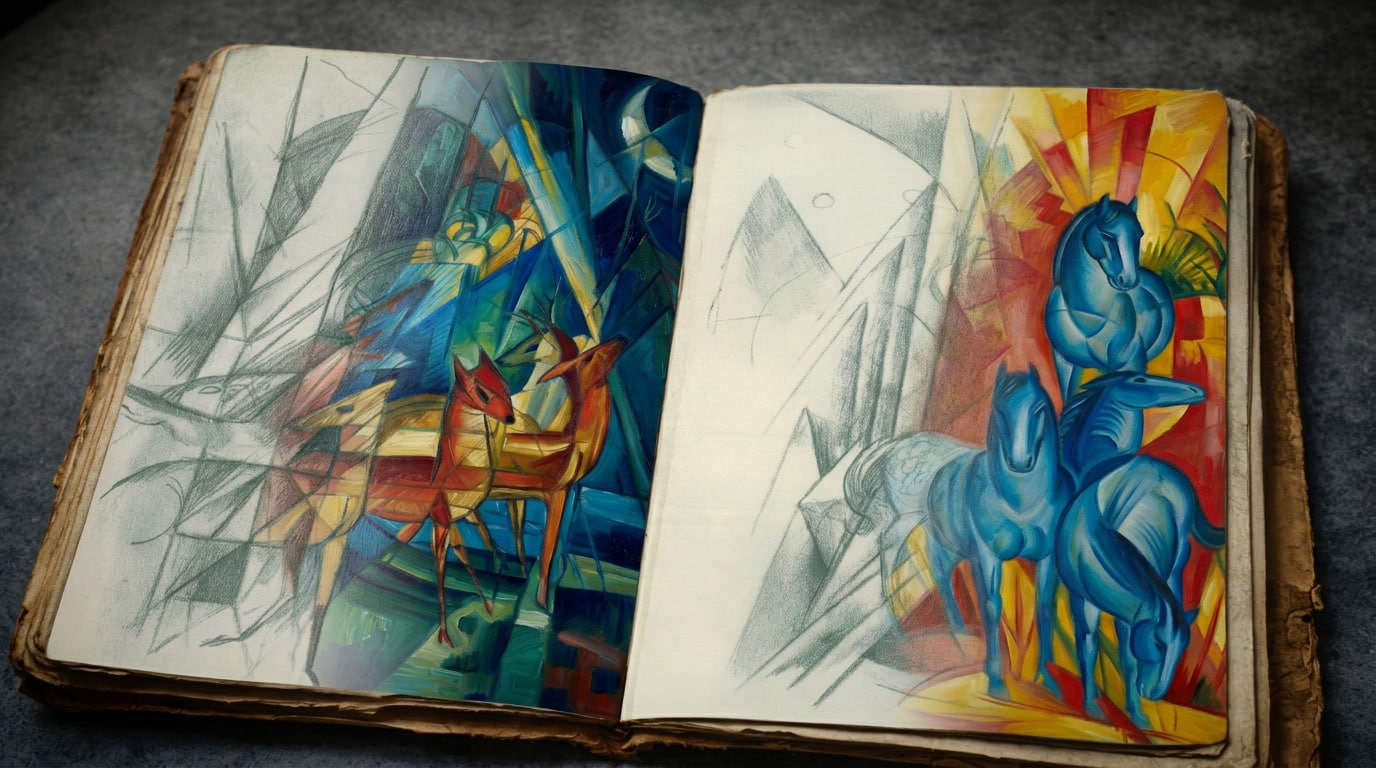
There are moments in art history that feel like a held breath. You stand in the Lenbachhaus in Munich, staring at these small, almost shy pencil drawings. Thirty-six sketches. Franz Marc drew them in 1915 right at the front near Verdun while the world around him was falling into shards. They aren’t battle paintings. They are visions of a purity he could no longer find in reality. And then that breath breaks. Marc falls in 1916. The sketches remain black and white, fragments of a future that never happened.
This is where our work at “The 37th Sketch” begins. We ask ourselves: what if? What if we could bridge that gap across the century? It’s not about copying Marc. That would be cheap. It’s about a kind of digital alchemy where we feed algorithms the metaphysical weight of his color theory. We take the raw energy of 1915 and let it shine anew in the light of the 21st century.
What Remains of an Artist´s Vision After 110 Years?
AI is often misunderstood as a cold, calculating tool that only regurgitates art. But when we train our models on Marc’s specific cycles—animal metaphysics, the utopia of order—something strange happens. The algorithm begins to recognize not just shapes, but logics. It understands that for Marc, blue represented the spiritual and masculine, yellow the gentle and feminine, while red, as matter, weighed brutally and heavily upon the composition.
When we take one of those field sketches, we don’t just feed the AI a command. We conduct a dialogue between historical intention and modern processing power. We use 4K resolutions and 300 DPI to create a depth that Marc probably would have loved. He searched for the essence of things, for the “Inner Truth.” Our technology is merely the new prism through which we view that essence today. It is a restoration of the possible.
How Does Franz Marc´s Color Theory Guide the AI Restoration?
Imagine this: a tiny pencil stroke, hardly thicker than a hair, becomes an exploding surface of indigo or cadmium yellow through our reconstruction. The challenge lies in respect. We know exactly from his letters and earlier oil paintings of 1913/14 how he constructed space. The abstraction of war he felt in his final days wasn’t chaos. It was a search for structure.
Our digital originals are therefore not mere files. They are manifestos of a delayed completion. When a Giclée print hangs in a modern apartment today, it’s not an anachronistic foreign body. It’s the continuation of a revolution that was stopped by a shell in 1916. We use AI as a medium to say the unspoken. This isn’t desecration; it’s a form of homage that would be simply impossible without today’s technology.
What Does it Mean When 1915 Meets 2026?
Perhaps that’s the true alchemy: that software based on silicon and electricity can capture something as ethereal as Marc’s longing for the “spiritual in art.” We bridge history by blurring the lines between the analog draft and the digital completion. It remains a venture. But every time a motif like “The Fox” or “The Peaceful Horse” appears before us in new, vibrant colors, we feel that the thread from 1915 has been picked up again.
